

The UK mostly runs on a big September intake for master’s programmes, but quite a few universities also open a smaller May (or summer) start. This option is useful if you missed the September or January deadlines, need a little extra time to sort your documents, or simply don’t want to sit around for a whole year after finishing your bachelor’s. The number of courses is more limited than in September, but it still works well for many Indian students who want to get moving sooner. The top universities in the UK which offer master's programs starting in May include Coventry University Northumbria University University of East London Brunel University London University of Greenwich and University of Bedfordshire. Keep in mind that availability can change every year, so always check the latest details yourself.
Why the May intake can make sense for master’s
Most UK universities plan their year around the large September start, with January as the second main window. The May intake is smaller and usually focuses on taught master’s in subjects like business, management, computer science, engineering, health sciences, and data-related areas. These programmes normally last about 12 months and finish around May the following year.
It’s a practical choice if you want to begin your studies without waiting too long. Because fewer students apply for May, the competition often feels lighter. However, you’ll have fewer programme choices and scholarship options compared to the main September intake. The campus also tends to be quieter in the first few months since most students join in autumn. For anyone planning to study in UK, the May intake often serves as a sensible backup when your timeline doesn’t match the bigger cycles.
Realistic timelines for the May 2026 intake
You have to move a bit quicker for May than for September. Applications for May 2026 usually open from late 2025 through early 2026, and most deadlines fall between January and April 2026. Some universities keep accepting applications on a rolling basis until the seats are filled.
A practical schedule goes something like this:
Late 2025 to February 2026: Research programmes and shortlist the universities that actually offer your chosen master’s in May.
February to March 2026: Prepare your documents and submit the applications.
March to April 2026: Receive offers, accept them, and handle any deposit or CAS requirements.
April to early May 2026: Complete your visa formalities and get ready to travel.
If you miss these windows, you’ll probably have to wait for the next September intake, so starting your research in late 2025 or very early 2026 helps avoid last-minute stress.
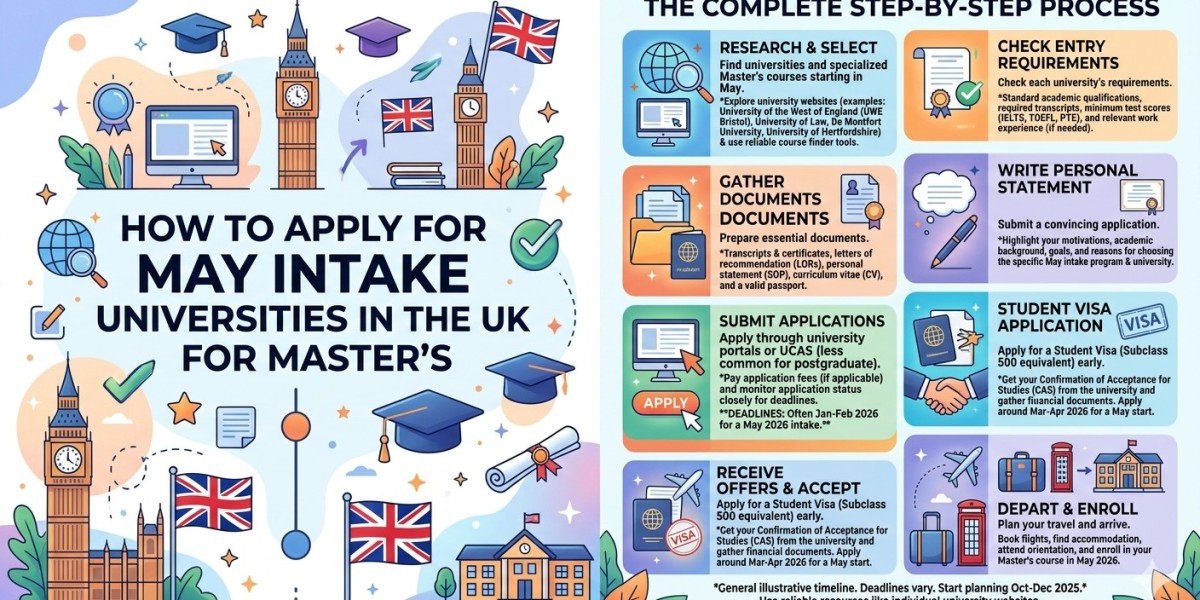
Step-by-step guide to the application process
You apply for May intake master’s directly through each university’s own online portal (UCAS is only for undergraduates). Here’s how it usually works:
Check availability first: Not every course runs in May. Go to the specific programme page on the university website and confirm the May 2026 start date, entry requirements, and fees. Popular fields include MBA, MSc International Business, Computer Science, Data Analytics, Engineering Management, and Public Health.
Meet the entry requirements: Most programmes expect a relevant bachelor’s degree with decent marks (usually equivalent to a UK 2:2 or 2:1), English language proficiency (IELTS 6.0–6.5 overall is common), and sometimes a personal statement or references. Some work experience can help, especially for business or management courses.
Gather your documents: You need to gather academic transcripts and degree certificates or provisional degree certificates and a passport copy and English test results and your CV and statement of purpose and your recommendation letters. The requirements state that all documents must be scanned and maintained at a high level of clarity.
Submit the application: Apply straight on the university website. Postgraduate taught courses often have no application fee, but always double-check. Many students get help from study in UK consultants at this stage to review everything and catch small mistakes before sending it off.
Handle the offer: Offers usually come within a few weeks. Meet any conditions (like final results or paying a deposit), then accept the offer officially.
Get your CAS and apply for the visa: Once conditions are cleared and the deposit is paid, the university will issue your Confirmation of Acceptance for Studies (CAS). Use this to apply for the UK Student visa. Try to submit the visa application at least 4–6 weeks before your travel date to give enough time for processing.
Things worth keeping in mind
Programmes in the May intake generally have the same academic standard and length as September ones, but the campus can feel less crowded in the first few months. Tuition fees and living expenses are similar across intakes, so plan your budget carefully. Student discounts and public transport passes are still available.
A lot of Indian students find it useful to speak with experienced study in UK consultants when targeting May-start programmes. They can help match your profile to suitable courses, keep track of exact deadlines, and guide you through the visa process though the real work and final decisions always stay with you.
If you’re thinking about a May start for your master’s, begin by making a shortlist of the best May intake universities in UK that offer your subject and keep checking their official websites regularly. Deadlines and course availability can shift a little each year. The May intake enables you to begin your UK studies through proper planning which allows you to maintain your academic progress without losing an entire academic year. The university websites should be your first source to find current information.